Investigating the pathogenesis of neurodegenerative diseases and developing new therapeutic approaches
The Mordes Lab investigates the mechanisms of neurodegeneration in ALS (amyotrophic lateral sclerosis), frontotemporal dementia (FTD), and Parkinson's disease (PD) with the goal of creating paths forward for the development of new targeted therapies. We integrate studies of patient brain samples with human stem cell-derived neurons using transcriptomic and proteomic approaches as well as traditional immunostaining techniques. We are particularly interested in the role of selective autophagy in the maintenance of protein homeostasis in neurons and developing therapeutic strategies to "prevent" TDP-43 pathology. We also collaborate with the Prusiner lab to investigate the role of pathological alpha-synuclein in movement disorders. Please check out this site to learn more about our team, publications, and current research projects.

Human stem cell-derived excitatory neurons
NEWS
- September 2026: Julie's excellent review article on the multiple roles of TBK1 is published.
- August 2026: Fun lab outing to South SF for the "Splash to Cure ALS". Thank you to the ALS Network & Denali for organizing.
- August 2026: Dan presented at the Live Like Lou ALS Research Symposium in Hershey, PA. Thanks to the LLL team.
- May 2026: Julie presents our latest research on TBK1 and autophagy at the Target ALS Annual Meeting in Boston. Thank you Amy, Manish, and all the TALS staff.
- April 2026: Manuscript on TDP-43 Pathology in CTE with Dr. Thor Stein, Dr. Ann McKee, and colleagues in Boston is accepted.
- April 2026: Dan gives a research talk to the Packard Center for ALS Research investigator meeting.
- Feb 2026: Dan presents on TBK1-ALS/FTD models at the inaugural Gordon Research Conference on FTD. Thanks to Aimee and Fen-Biao for organizing.
- Dec 2025: Julie is awarded a Springboard Fellowship from Target ALS! This will accelerate her research on ALS and autophagy.
@MordesLab
The Mordes Lab values the uniqueness of everyone. We strive to uphold a safe, creative space for scientific collaboration and pursuit.
We welcome enthusiastic graduate students and post-doctoral fellows to join our group (see open positions)!

Example of iPSC-based modeling of neurodegenerative diseases. Disruption of protein homeostasis (via proteasome inhibition) is sufficient to induce mislocalization of the ALS-associated RNA-binding protein TDP-43 from the nucleus to the cytoplasm in the human pluripotent stem cell-derived motor neurons.
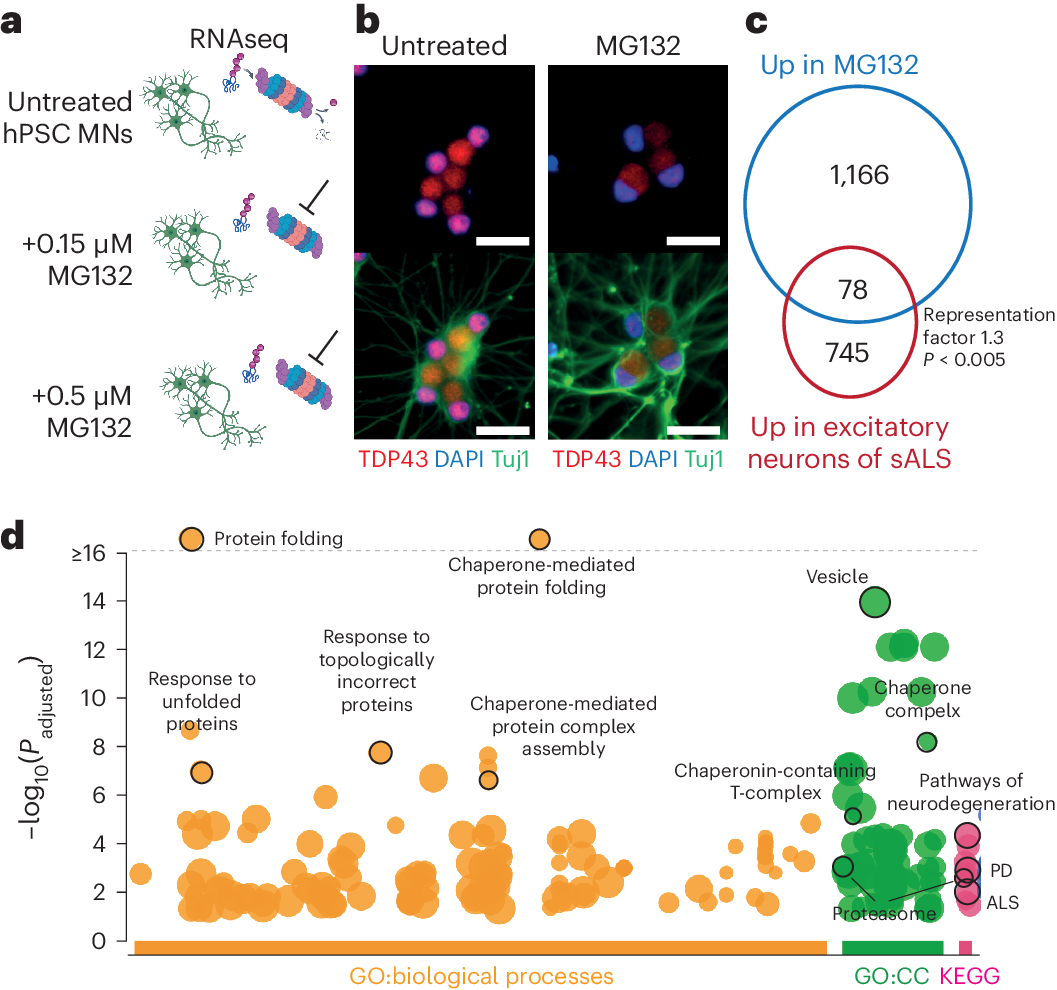
From (Nat Aging) DOI: 10.1038/s43587-024-00640-0.

Mordes Lab @ Weill Building for Neurosciences
1651 4th St., Mailroom 471A
San Francisco, CA, 94158, USA
(415) 353-1587