Investigating the pathogenesis of neurodegenerative diseases and developing new therapeutic approaches
The Mordes Lab investigates the mechanisms of neurodegeneration in ALS (amyotrophic lateral sclerosis), frontotemporal dementia (FTD), CTE, and Parkinson's disease (PD) with the goal of creating paths forward for the development of new targeted therapies. We integrate studies of patient brain samples with human stem cell-derived neurons and mouse models using transcriptomic and proteomic approaches as well as traditional immunostaining techniques. We are particularly interested in the role of selective autophagy in the maintenance of protein homeostasis in neurons. We also collaborate with the Prusiner lab to investigate the role of pathological alpha-synuclein in movement disorders. Please check out this site to learn more about our team, publications, and current research projects.

Human stem cell-derived excitatory neurons
NEWS
- Dec 2025: Julie is awarded a Springboard Fellowship from Target ALS! This will accelerate her research on ALS and autophagy.
- Oct 2025: TBK1 and OPTN ALS/FTD proteomics study published in Cell Reports. Congrats to Julie and team!
- July 2025: We welcome Sara to the lab, who's an expert on ALS and RNA biology.
- May 2025: Congrats to Julie for winning first prize for her poster on TBK1-ALS/FTD research from the ALS Network Barber Research Award.
- May 2025: Dan presents on TBK1 at the Target ALS Annual Meeting in Boston. Thank you, Amy, Manish, and the entire TALS team.
Follow us on X: @MordesLab
The Mordes Lab values the uniqueness of everyone. We strive to uphold a safe, creative space for scientific collaboration and pursuit.
We welcome enthusiastic graduate students and post-doctoral fellows to join our group (see open positions)!

Example of iPSC-based modeling of neurodegenerative diseases. Disruption of protein homeostasis (via proteasome inhibition) is sufficient to induce mislocalization of the ALS-associated RNA-binding protein TDP-43 from the nucleus to the cytoplasm in the human pluripotent stem cell-derived motor neurons.
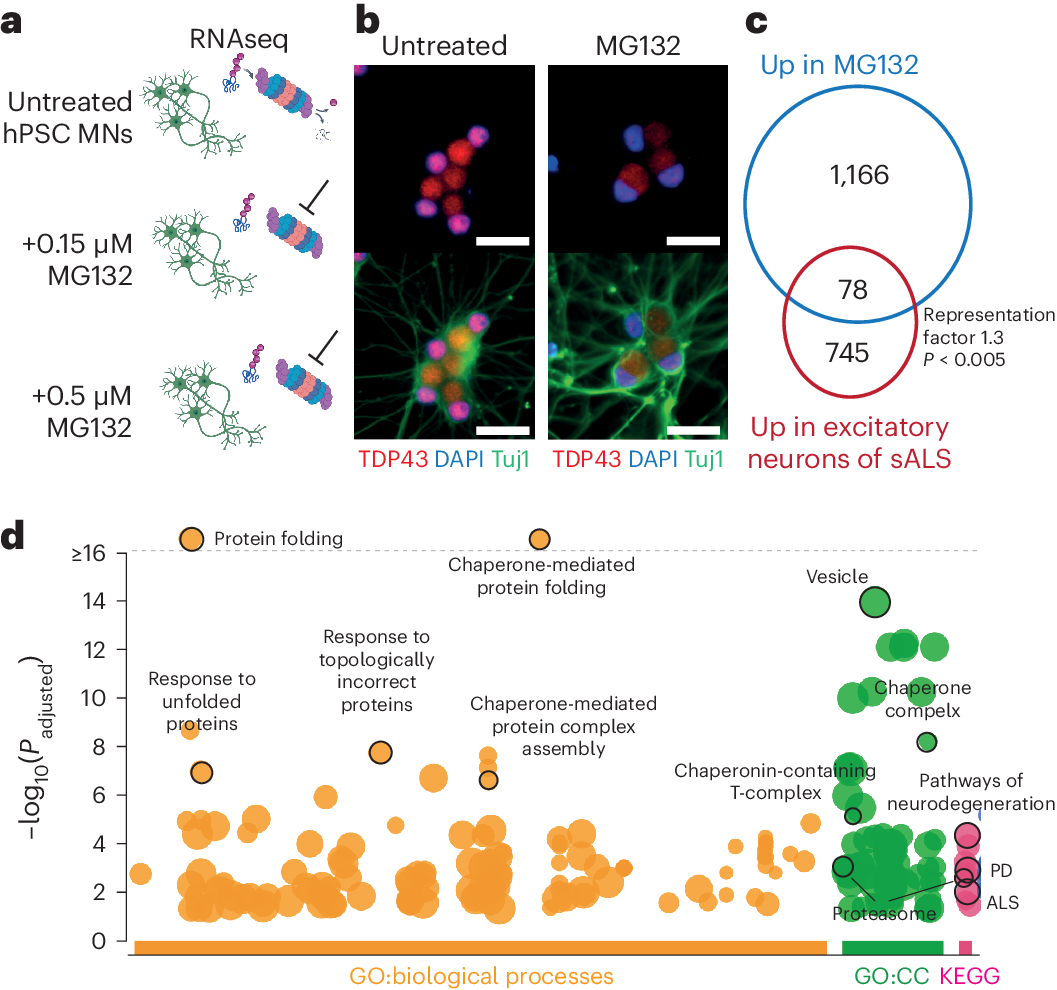
From (Nat Aging) DOI: 10.1038/s43587-024-00640-0.
Daniel A. Mordes, MD, PhD
1651 4th St., Mailroom 471A
San Francisco, CA, 94158, USA
(415) 353-1587